Showing posts with label kayak fishing. Show all posts

Wednesday, December 3, 2014

Galveston Island State Park by Kayak

     500 years before my first kayaking experience at Galveston Island, a people called the Karankawas, who paddled these waters in their own dugout canoes, encountered a shipwrecked Spaniard by the name of Cabeza de Vaca. De Vaca provided the first written description of native Texas inhabitants, including these nomadic fisherman, who hunted and fought with long cedar bows and were also known as "the wrestlers" for their grappling competitions. Although De Vaca would go on to interact with many tribes and eventually lobby against their exploitation, later Europeans would not be so civil. The French-American pirate Jean Lafitte finally devastated the Karankawas in 1819 when his small army kidnapped one of their women and then crushed those who retaliated with cannon fire at an area less than 5 miles from the State Park.

   Although humans have fished and paddled the shore and bays around the island for centuries, I still felt like an explorer as I searched the sprawling bay for unsuspecting redfish and speckled trout among the seagrass. The Galveston Island State Park paddling trail is divided into 3 smaller trails that wind through adjacent sections of the bay, and are only divided by muddy masses of marshland. The trails aren't distinct paths (or maybe they are and I was bad at finding them) but rather seem like suggestions on how to navigate the mostly open water.


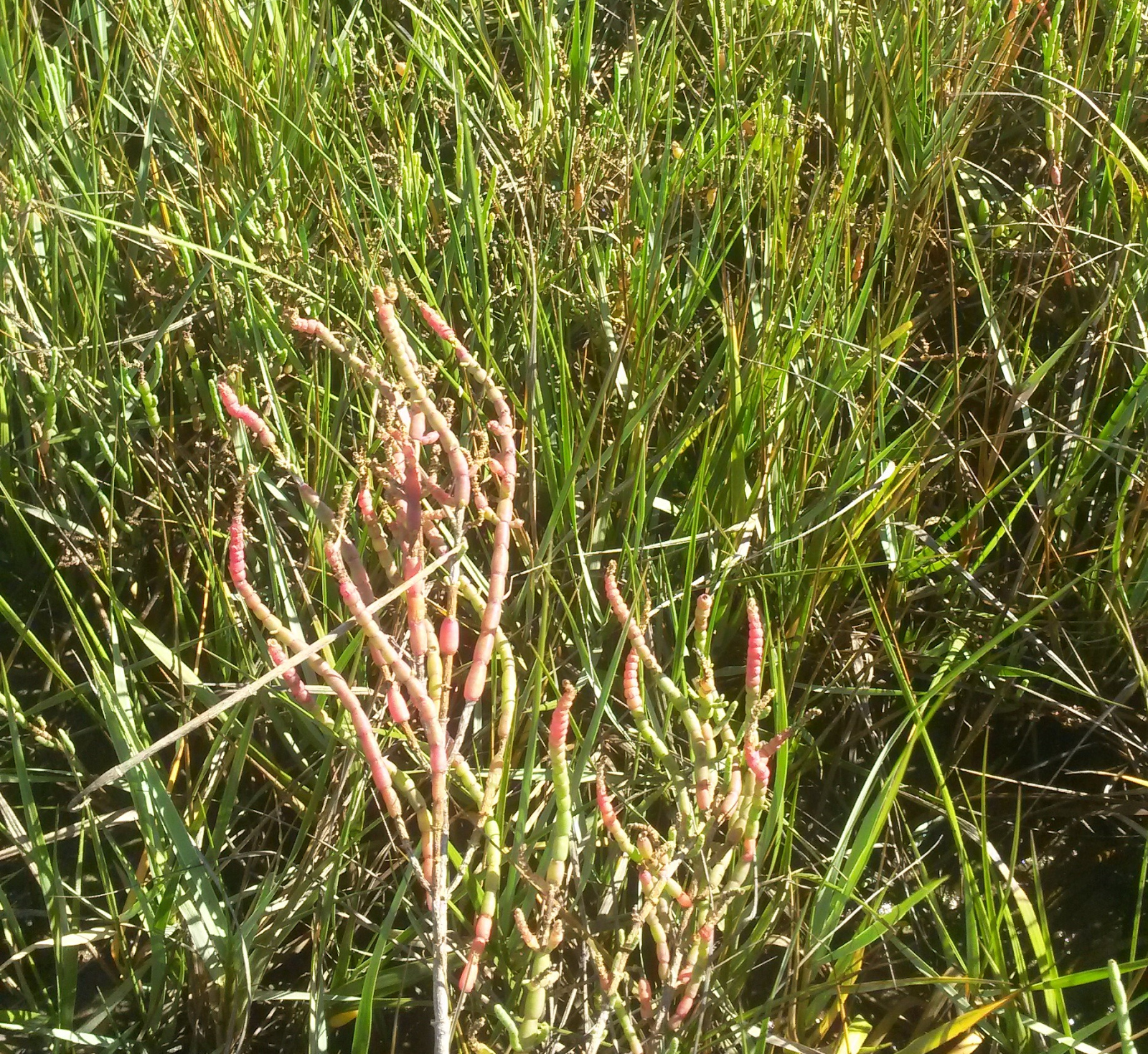
Seagrass (pictured terribly above) is the natural habitat of baby shrimp and other small creatures that are scientifically classified as "bait"

   My kayaking buddy, Jadd, and I arrived at the park around 8:30 am, and picked out one of the 3 kayak launches to start from. Since we ended up wasting so much time fighting heavy wind and current trying to find the best spots, I've included the park map and our eventual path. We launched at Como Lake, intending to follow the first part of the Dana Cove trail and then jump over to the Oak Bayou Trail. But as soon as we were on the water and I tossed my first live shrimp into the channel east of the trail, my line tightened as my shrimp shot under the kayak. "Fish On!" I taunted, but Jadd was already hooked up as well. I landed a beautiful speckled trout to start the morning, but I could tell it was an inch or two short of the limit and tossed it back. Jadd had similar luck with two undersize reds, but the wind kept sweeping us back to the bank so we decided to get back to the trail. Again, I was reminded that I really need to start bringing an anchor for the times when I find a good fishing spot...

The actual trails are marked with lines and numbers, I marked our path in green. The fishing spot is marked with the appropriate internationally recognized symbol.


   Unfortunately for us, we spent the rest of the day attempting to follow the coastline, but getting disoriented between masses of grass. The water was shallow, maybe 1-2 feet deep in most places, and the abundance of seagrass on the bottom was promising, but we had a hard enough time just fighting the current and the wind, let alone finding any fish. Eventually, Jadd had had enough, and I spotted him dragging his kayak into the mud (I wonder why this gave me deja vu). Pointing out "tire tracks", he suggested we leave our kayaks, walk back to the car and pick them up, since we had obviously gotten lost on our way to the second kayak launch. It quickly became clear though, that this was not a road at all, and that we'd have to drag our yaks quite a ways to get back to the parking lot. Maybe it's a good thing these trips never go too smoothly, or else they'd get boring.


Jadd pouting
Discovered a new species, which I shall call "rattlesnake grass"


  We finally saw the parking lot and kayak launch where we should have ended up, and got back in our yaks to cross a small section of water to get there. From there, we left the kayaks in the bushes, hiked back about 1/3 of a mile to the car, and came back to pick them up. We still had some shrimp, so we tried our original spot one more time. Sure enough, the fish were still biting, but after struggling to catch one fish, we realized the wind was way too strong by now and without anchors, we'd have to call it a day.


Can you spot the snake?
How about now?


How about now? No? Please see a doctor.

   All in all, Galveston Island State Park seems like a cool place, even though the paddling trail proper didn't have much in the way of diverse scenery to offer. There are certainly fish to be caught nearby, and the rest of the park appears to offer decent birdwatching and hiking serenity. There are camping sites too, but I'd only recommend them if your idea of camping is pitching a tent in a grassy glorified parking lot next to an RV.


Jadd beaming with pride with his non-even-close-to-the-legal-limit redfish

    As per the last time I drove by Clear Lake, I stopped back in at El Lagos Coffee Shop on the way back, and also discovered a new hole-in-the-wall worth a recommendation. Stompy's burger shop in Seabrook definitely hit the spot after an arduous day of paddling against the wind with their unique burgers, quality beef, good fries, and a choice of wheat buns. (That's 4/5 on my burger joint list, the 5th being huge burgers. These were merely decent sized).

Just about 56 trails to go!


Friday, October 3, 2014

Sharkathon by Kayak


     On a windy October day in 2013, a husky man with a reddish-blond beard paddled his kayak hard to overcome crashing waves, determined to deliver his cargo. He was 150 yards away from the beach; just another couple hundred yards and he could throw the chunk of fish, skewered on a giant hook and hanging haphazardly off the back of his vessel, into the water. But the next wave hit him unexpectedly hard, knocking him into the surf, and as his kayak flew backwards, the plastic-coated metal line flailed, wrapping around his neck. The sudden jerk of another wave compounded his situation, jabbing the tip of the great hook into his neck before burying it past the barb. Only sheer luck and the help of nearby fishermen saved his life, but rather than being airlifted to safety, he doggedly drove himself to Corpus Christi, had the hook removed at a hospital, and drove back to continue fishing in the biggest tournament of the year. For some people, Sharkathon is life. 

Sharkathon 2014


       Each fall, hundreds of anglers head to Padre Island National Seashore (also known as PINS) to compete in the largest shark fishing tournament in Texas. The following was supposed to be an epic account of my weekend at PINS, where I observe the beautiful wildlife, kayak-surf through killer waves, and battle massive sharks by rod and reel to win the $20,000 grand prize. Super fun tips along the way would explain the ins and outs of shark fishing from the beach, and how anyone can do it, providing an intriguing and educational read... Maybe next year.


Welcome to PINS

     While waiting in line to check in for Sharkathon on Friday morning, I overheard two sun-baked contestants with several missing teeth discussing last year's tournament. They spoke of the angler in the story above, who found himself wearing a rusty necklace after flipping his kayak in the surf. I looked out uneasily at the crashing white-capped waves and felt my stomach doing gymnastics. 


Passing some typical Sharkathon constituents....

     My job at Sharkathon has always been to kayak the baits out, often fighting heavy currents and pounding waves. The further out you can drop off a bait, the greater your chances of landing a prize shark. The key is to get past the sandbars, thin areas where the water is suddenly shallow, that divide the water into deeper and deeper guts. Sandbars can be identified by the breaking waves, or "breakers" that crash over them, with the first sandbar being pretty subtle and close to the shore, depending on the tide, and the second and third being further out and marked by larger waves. Beyond the breakers lies the promised land, where the sea is generally calmer and deeper, and large sharks roam.

    It took over 3 hours of driving, over rolling mounds of sand and wild grasses, to reach the 55-mile marker, beyond which the "road" appeared impassable. We had hoped to make it 60 miles to the rocky jetty that marks the endpoint of PINS and also protects the last mile or so from some of the seaweed, a shark fisherman's worst nightmare. But at least the spot we picked to camp and fish at was mostly weed-free, as opposed to the rest of the water we had passed on our way, although the waves appeared rougher here than they had been near the entrance...

"Do a Barrel Roll!"


    Over the next day and a half, I only made one successful run at dropping a bait. The following video summarizes every other attempt:


           Oh yeah, I finally got a GoPro to record video while paddling! It really doesn't capture the brutality of the waves, as on this particular trip, the problem had more to do with the power and number of waves as opposed to sheer height. (Frequency and Wavelength vs Amplitude if I remember physics class correctly)


Shark Bait #1

    At one point, the waves knocked my kayak into my friend's forehead while he steadied the vessel for me to jump in, opening a slit above his left eyebrow. It bled for quite a while, and I regretted not bringing sutures and Lidocaine with me from work like I had been considering. It could have been fun to do some wilderness first aid. Oh well, bandages and Neosporin would have to do. I had also been tossed into the water about ten times by now, and seaweed had crept in to tangle our line, so we knew our fishing spot had become obsolete.

Notice the two bird species. To the left, a flock of pelicans, aka a "pod". To the right, A Flock of Seagulls flies (so far away)


   Fed up with the conditions, we moved to the 60 mile marker on Saturday morning, day two of the tournament. The drive was rough, but we finally made it onto a large sandy platform right by the jetty. Unfortunately, the waves looked almost as violent here, but there was no seaweed, so we gave it a shot. The only other group that had made it this far still had their kayak tied atop their SUV, choosing instead to cast baits out as far as they could and catch whatever the first gut would offer between crashing waves. They looked on in disbelief and shook their heads as I began to paddle out, surviving the first set of breakers thanks to my friend giving me a good push.


Shark Bait #2, Skipjack (or Ladyfish, I can't tell the difference)

     Bait Drop Soup


     I paddled forward and aimed for a weak spot, where a large wave appeared split into two parts. The kayak bounced over with a thump before another wave smashed my face, but the vessel held steady. I was past the second sandbar, but the third loomed ahead. And beyond that, I could see that the waves were capped with white all the way to the horizon. There would be no calmness after the breakers.

    As the next set of waves pounded me, blinding my eyes with a salty spray, I wondered what my last thoughts would be if a hook skewered my neck. The kayak rocked sideways, but I got lucky with the timing and missed the worst of the wave. I was out about 300 yards from the beach now- far enough to catch a good shark. I continued forward, but panicked when 3 consecutive waves towered like mountains ahead. There was no going through, and I was seconds from getting thrown into the water. My brother could see this, and garbled something through the walkie-talke, but I already knew what to do. I yanked at the line, hurriedly dumping it all, followed by the weight, and finally, the fresh skipjack into the churning water just before a huge wave punched my kayak sideways and sent me somersaulting through the surf.


The sea rages

   When I got back, we celebrated our only successful bait drop and began to wait and hope a shark would join our party soon. I knew that in these conditions, it was a drop like this that could win the tournament, and wished that we had used a more durable bait, like a stingray. Sure enough, the skipjack got chewed up, probably by a pup shark that missed the hook, and only lasted an hour. By that time, it had started raining, the wind had picked up, and kayaking was no longer possible at all. The tide had also risen, and we began to worry that the sandy cliff we were parked on would collapse overnight if the weather became stormier.


     Survival Mode


     The wind nearly picked up our tent that night, so we crammed into the truck for shelter from the rain. Not only could we no longer fish, we couldn't even drive home early. We had driven too far and now we were stuck, and there was no way of knowing when the beach would become passable again. I couldn't believe we were stranded; what if we were stuck here for days? What if the tide roared up to the sand dunes in a storm surge, swallowing the truck, with us inside? 

Kayaking Tip #6: eat lots of fiber so you can stay regular while camping in the wilderness with no amenities....actually, no, cancel that tip

    I prepared to reprimand my friends, since I had voted to head home much earlier, but they were already ahead of me. "What kind of idiots do something like this?" my brother asked rhetorically. We all came to the realization that the kinds of people whose lives revolve around Sharkathon each year are probably not the kinds of people we wanted to emulate. There was a vast, wild world out there to explore, and I'd be happy to huddle in a tent, pounded by rain, if I was traversing a new country, backpacking through a mountain range, or floating hundreds of miles down a river. That was the whole point of starting a kayaking blog, to try new things, not get stranded in the same place with the same people, catching the same fish...


Proof that my team and I have actually caught sharks on previous trips. *Colors removed to indicate throwback nature of picture

      With no phone signal, and only enough gas to drive back, we wondered how to pass the time in the dark cabin of the truck. I snatched a bag of chips from my friend, "This is now a SURVIVAL situation, stop eating!" Sleep didn't come easy, and I remembered my waterproof journal, picking it up in hopes of writing something creative or doodling a fun comic.


Dear Diary Journal,

    Morning finally came. The rain had stopped and the tide was low enough to expose drivable sand, but waves smashed through the water harder than ever, and the surf was now brown with sand after the evening storm. Zooming past the 55 mile marker, we were relieved of our morbid ideas about dying at Sharkathon, and swore blood oaths never to come back. Well, until next year anyways, as long as the weather forecasts weren't awful again and we could build a safety latch to hold the hook inside the kayak. Twenty grand is twenty grand after all.


     For now though, I think I'd like to head inland to explore the next paddling trail. There are actually 58 left to go, since the TPWD added another one just the other day. Freshwater ho!
   

Sunday, September 21, 2014

Armand Bayou (Mud Lake) by Kayak

  In 1970, an armed robbery tragically ended the life of Armand Yrmategui, a tireless defender of Houston-area wetlands. It's a good thing everyone called him Armand, because the body of water then-known as Middle Bayou was named in his honor, and Yrmetegui Bayou Nature Center would have caused all sorts of spelling anxiety for the elementary school children who go there on field trips.

   The TPWD Paddling Trails are split into two groups, inland and coastal. After the last two kayaking trips, I really missed the saltwater and actually catching fish, so I decided to explore a coastal trail. Armand Bayou starts as brackish where it connects to Clear Lake before transforming to freshwater upstream by the Nature Center. Interestingly enough, this means that in certain areas you can target largemouth bass and redfish at the same time! Even more intriguing is the possibility of being mauled by a bull shark while an alligator is still in mid-death-roll after flipping your kayak.

  While most trails have distinct starting and ending points, Armand Bayou Paddling Trail is more of a branching system that encompasses a lake, so for today, I only explored the saltier portion named Mud Lake, just above Clear Lake. My objective was to catch some redfish, the golden creatures that have decorated the cover of so many Texas fishing and outdoor magazines. Unfortunately, I didn't begin my mission until around 8:30, since no bait shops in Clear Lake open before 8am. This is the grievous equivalent of a stock broker on Wall Street waking up at noon!

A goofy bird under the bridge. Snowy Egret, actually. Easily identified by its clown shoes.


    Armed with a bucket full of live shrimp, I launched out of Clear Lake Park, right by the bridge that separates the lake from Armand Bayou. I have distinct memories of this park from many childhood family picnics. Although we were quite successful at crabbing, I never once saw anyone catch a fish in this seemingly desolate lake. For the uninitiated, crabbing is the ingenious redneck activity of throwing a perfectly good chicken drumstick off a dock, and slowly retrieving it, along with a clinging, palm-sized crab, inside of which you may find about a quarter ounce of meat if you break the claws just right and save all the stringy white shreds.

   After maneuvering my kayak under the bridge, I realized that the difference between this area and Clear Lake, at least the part by the park, is the existence of cover and structure to fish around. Tall grass lined the bank, and some kind of floating plant littered the water beyond that. I believe these clumps of floating life are water hyacinth, an invasive and destructive species, but I could be wrong. A log jutted out of the plants, and a dark blue, hipster-looking bird wearing a mohawk loitered confidently atop it. It glided off before I could snap a blurry picture, but based on my research, I believe it was a Belted Kingfisher. Pretty cool, although I'll have to come back to view the rest of Armand Bayou's famous wildlife, including some very unique-looking birds called roseate spoonbills and even nesting alligators in a branch named Horsepen Bayou.

Mud Lake, Armand Bayou. How many egrets can you spot?
   As I drifted parallel to the grass, I used my fancy bass rod to attempt to entice fish with a brownish soft plastic lure attached to a small spinning spoon. I had a good feeling about this setup when I bought it at the store, but my fisherman's intuition has never gotten me very far when it comes to using artificials. With my cheaper rod, I threw in a live shrimp and let it soak. Skilled fisherman call this technique "cheating".

   Within a few minutes, my live shrimp was hit, and line was zipping off  the Walmart rod as the culprit made an attempt to escape. It didn't put up too much of a fight, and I scowled at the sight of my first catch. It was a hardhead catfish, basically the worst fish ever. They are slimy, have sharp spines armed with a painful toxin, make disgusting croaking sounds, eat more garbage than mullet, and steal any live bait you may put on your hook. In fact, among my regular fishing buddies, hardheads count as negative points when competing for daily fish counts. 

Why


     Soon after, my rod went off again, except this time, the fish weaved and fought like it valued it's own life, so it couldn't possibly be a hardhead. Almost losing it in a clump of plants, I swung the fish into my kayak and smiled as I recognized my target species. Rarely do I analyze a new spot and catch the fish I am seeking, so even though it was a dinky 12-inch red, I was pleased that my score was back to zero. I released the fish, since it was well beneath the legal limit, and gave up on artificials, switching out my plastic lure for a shrimp under a floating cork, so I could keep an eye on it while holding the other rod which was rigged with a second, free-lined shrimp. 


That golden sheen


   While unhooking another hardhead, I saw my orange and green cork shoot under the water while the line let out a satisfying zzzzzzzzz. Cursing the catfish's mother in 3 languages, I threw it overboard and grabbed my second rod, reeling fast to catch up with the fish. I let it tire out a bit while fighting it steadily to the yak, keeping the pressure up in order to avoid losing the fish. "Yes!", I said to no one as I saw the golden sheen of it's tail swiping the surface. I knew it was a redfish just from a flash, since it's color contrasts starkly with that of a hardhead's gray with copper highlights, the exact tint of a rusty bucket used to contain human waste and vomit in a medieval torture chamber.


The safe way to hold a catfish is under the arms (fins) like a baby. A disgusting, croaking, slimy, baby that you must immediately hurl to the bottom of a bayou.

   As I netted the fish and scooped it into my boat, I stopped holding my breath to celebrate. I opened my tackle box to take out my stringer, preparing to keep the fish fresh for later consumption. As an afterthought, I decided to measure it to make sure it was legal. I didn't have my tape, so I used the tackle box as a guide, only to realize the impressive looking fish was still undersize....by about 3 inches. In Texas, redfish must be between 20-28 inches to keep, which seems pretty oppressive, but I guess there is a science of conservation and such behind it. I reluctantly slipped the fish back into the water and fished for a bit longer before deciding to try another spot.

Looked big enough to me. Damn

   I reached mile marker number 2 soon, and stopped near some more grass. I had trouble fishing without any structure to tie my kayak to, and made a note to bring an anchor next time. I didn't make much more of an attempt to explore Mud Lake, as it seemed pretty bland to me, so next time I will start at the Nature Center and try to catch bass, as well as a glimpse of a gator or spoonbill.


There's always a spider, somehow

  On my way back to the launch point, I stopped at my first fishing spot. Deciding to finish strong by fishing a shrimp on both rods simultaneously, I realized my cheap rod had disappeared, probably while I tried to anchor myself in a mess of floating plants and grass. Oh well.

"You're gonna get hop ons"

   I let a stranded lizard perch on my shoulder while I caught one more seemingly nice redfish, but again, it came up a bit short. At this point, I decided to do one good deed for the day and take the lizard back with me, since he may have gotten stuck on the clump of hyacinth and I'm not sure if normal lizards can walk on water. It was nice having a paddling buddy, even though he had no haiku-writing skills whatsoever.

Fishing buddies. He looks like a Thomas.

    Most of my remaining shrimp were dead by now, so I decided to call it a day. If I come back to this spot again, at least I'll know where to look for reds (west side of Mud Bay along the grass, just a few hundred yards after the bridge) , although I would try to get shrimp the night before and fish at dawn for a chance at larger fish. On the way back, I saw a large pink canoe, rowed by a pink-clad army of girls, and led by a woman wearing a pink tracksuit and barking orders while they counted loudly in military fashion. I'm not sure what was going on here, but my guess is that this was the most hardcore group of girl scouts in Texas earning their rowing badge the hard way.

   While loading everything back into my car, I realized that Thomas was gone. You just look away from your lizard for a few minutes and.....I hope he reached safety, but after losing my rod and my fishing buddy, I needed a pick-me-up, so I met some friends at a nearby coffee shop. If you are ever in Clear Lake, definitely check out El Lago Coffee and Antiques. 


Some actually useful antiques

   It is basically an older couple's house that they have transformed into a tiny cafe/antique shop. I don't really believe in antiques, especially in this case, since it was basically a permanent garage sale with useless and obscure junk. But the man roasts the beans in his backyard, where you can enjoy the aroma while dining on homemade cranberry scones. The coffee is also excellent, especially the Red Cloud variety, which they import from Guatemala. After a mostly sleepless night, I was worried about driving home, so I ordered a cappuccino to keep me awake. The espresso was so strong, though, that I have been fired up all day, and wrote this whole post in one sitting, without any breaks or even punctuation between sentences! That's what editing is for, anyway. So although this paragraph has nothing to do with paddling trails, I want to promote this cafe in case anyone wants to take after the Belted Kingfisher and be anti-establishment instead of going to Starbucks.


An "antique" book I kind of wanted for my coffee table. But no price was listed and I figured it would be very outdated anyway. Also, I don't have a coffee table.

The next post should be action-packed, although it also has nothing to do with paddling trails, but everything to do with the most intense shark fishing tournament in Texas. Just 57 1/2 trails to go!